Training Tip: Why and When I Introduce Spurs to My Horses
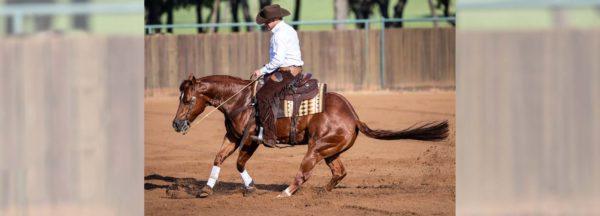
When I start a horse under saddle, my first two goals are to establish a gas pedal and a brake. A gas pedal refers to the horse increasing his speed as soon as you gently squeeze his sides with the calves of your legs and maintaining that speed until you cue him otherwise. If a horse has a good brake, he immediately stops when you sit deep in the saddle and relax your body.
Once you have a good gas pedal and a good brake on a horse, you can start working on a steering wheel— controlling the direction the horse goes in.
Following the Method, we teach a horse to establish a gas pedal, brake and steering wheel by practicing the Fundamentals exercises One Rein Stops, the Cruising Lesson, Follow the Fence, and Diagonals. Each of these exercises is what I refer to as a controlled impulsion exercise; you’re creating forward movement in the horse. It’s impossible to do anything with a horse that doesn’t have energy in his feet or with one that runs off with you.
Once a horse has a good gas pedal and brake and you can steer him, then you work on suppling exercises. Suppling exercises are designed to get the horse soft and responsive to your hands and legs. Bending at the Walk and Bending Transitions are great examples of suppling exercises included in the Fundamentals Series.
To get a horse that’s both responsive and relaxed, you have to balance impulsion exercises with suppling exercises. Too much of either one is no good. If you focus on only impulsion exercises, your horse will readily move forward, but he’ll likely be stiff and heavy. If you only work on suppling exercises, your horse will be soft and light, but when you ask him to move forward, he’ll cop an attitude.
When I begin to work on suppling exercises, I start to use spurs. Spurs are nothing more than an extension of your leg, just as the Handy Stick is an extension of your arm when you’re doing groundwork. Spurs are only to be used to move the horse’s five body parts and to soften and supple his body. They should never be used to get a horse to speed up or to make up for shortcomings in a horse’s training.
The reason why I introduce spurs when beginning suppling exercises is because often during these exercises horses have a tendency to lean on your leg and ignore you. That’s where using spurs as reinforcement to your leg cues is important. It teaches the horse that if he chooses to ignore you, there will be a direct consequent.
Now of course, you do not need to use spurs if you don’t want to. It is possible to get a horse to bend and soften with your bare heels. However, it takes a lot more time and you’ll never get the horse truly soft. Horses are a lot like us. From time to time, they’ll get lazy and cheat you by not putting in much effort. It’s in those instances when spurs are beneficial.
If you’re following the exercises in the Method, the first time you’ll use spurs with your horse will be the Fundamentals exercise Bending at the Walk.
Have a horsemanship question or looking for more training tips? Check out the No Worries Club.
