Training Tip: Practice Transitions on the Trail
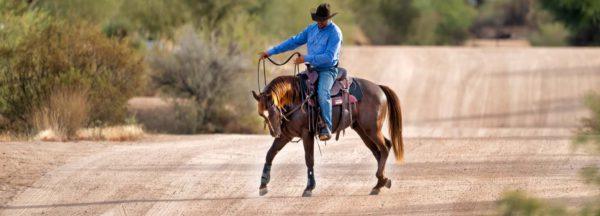
When training horses on the trail, focus on transitions on the way home to keep your horse engaged with you. Our usual approach is after letting the horses spend three or so minutes walking on a big, loose rein to relax, we start giving them little puzzles to solve. We might trot forward and then come down to a walk and counterbend or two-track. Or walk the horse forward and then back up. Or you might practice Bending Transitions from the Fundamentals Series. The possibilities are endless.
We work on transitions for five to six minutes and then go back to letting the horse walk on a big, loose rein. We let him have his “friendly time” for two to three minutes and then get back to asking him to engage with us.
For the most part, during this portion of the ride, we stay away from the lope because we don’t want the horse to think that when we turn for home it means speed up and get there quickly. That’s a good way to teach a horse to be barn sour. Instead, we work on a lot of walk-to-trot and trot-to-walk transitions. That allows us to keep the horse engaged with us and to work on softening and suppling his body in a low-key, relaxed manner.
Looking for more training tips? Check out the No Worries Club. Have a training question? Send it to us at [email protected].
